
.png)


There is a moment every first responder knows. The engine pulls back into the bay, the radio goes quiet, and the uniform comes off. For a few seconds it looks like the shift is over. But the call that just happened, the one where someone didn't make it, doesn't clock out with the gear. It rides home in the front seat.
That's the part most people never see. The public watches first responders run toward danger and calls it heroism, which it is. What gets missed is what happens after, in the kitchen, in bed at 3 a.m., in the silence when a spouse asks "how was your shift" and the honest answer is too heavy to say out loud.
The Numbers Tell a Story Most People Don't Hear
Trauma exposure in this line of work is not the exception; it is the baseline. A widely cited review of paramedics found PTSD averaging around 7 to 37 percent across studies, alongside significant rates of depression and anxiety.
Roughly 400,000 U.S. first responders have been diagnosed with PTSD, and while about 20 percent of the general population may develop PTSD at some point, that number climbs to about 33 percent for first responders.
How Trauma Crosses the Threshold at Home
Mental health professionals often describe this as cumulative trauma: the layered effect of repeated exposure to distressing calls, losses, and high-stakes moments over time. It rarely announces itself. It shows up as a short temper, a flinch at a loud noise, or a refusal to talk about work at the dinner table.
There is also a quieter wound called moral injury, the distress that can come from witnessing or being unable to prevent something that violates a person's own sense of right and wrong. At home, moral injury may look less like fear and more like guilt, anger, withdrawal, or a feeling that no one could possibly understand what happened.
What Families Actually Notice
Spouses, kids, and partners are often the first to see the signs, even before the first responder does. Common patterns include:
- Withdrawing from conversations about the day or the job entirely
- Sleep that never feels restful, paired with recurring memories of bad calls
- Irritability or anger that seems disconnected from what's actually happening at home
- Emotional distance, even during good moments like birthdays or holidays
- Avoiding triggers, like certain routes, sounds, or news stories
None of this means someone is broken. It means the nervous system is still running the call long after the call ended.
Why "Tough It Out" Doesn't Work
The culture of first response has long rewarded stoicism. Asking for help can feel like admitting weakness in a job that demands the opposite.
But research shows stigma is one of the biggest barriers standing between first responders and care, often outweighing the trauma itself. The job will always ask people to be strong in the moment. It cannot also demand they stay silent afterward.
Bringing the Job Home, Together
Healing does not require leaving the profession behind. It requires building a different relationship with what the job leaves behind. That starts with a few honest shifts:
Trauma will likely always be part of the job description for first responders. But it doesn't have to define what happens at home. With the right support, those front-seat passengers, the calls that linger, can be acknowledged instead of buried.
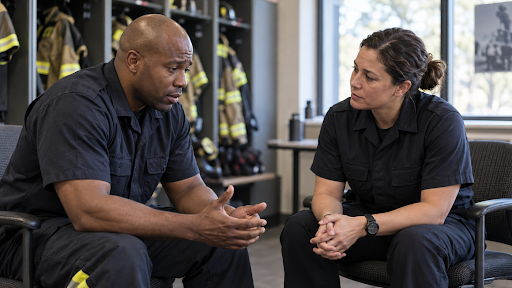
That first step might be a peer conversation, a confidential counseling call, or simply telling someone at home, ‘I do not need to explain the whole call, but I do need a quiet minute.

.png)





.png)