
.png)



Your most expensive business decision this year might not be a bad hire, a failed product launch, or a missed sales target. It could be the wellness program you never built.
Right now, your employees are showing up. They are answering emails, joining calls, and hitting deadlines. But a growing number of them are running on empty, and the business is quietly absorbing that cost across every department.
A corporate wellness platform is not a perk you offer to look good on a job listing. It is a business infrastructure decision, and the companies still treating it like a bonus benefit are the ones paying for it in healthcare claims, turnover, and a workforce that is physically present but mentally somewhere else entirely.
The Current State of Workplace Wellness
Workplace stress and burnout have reached critical levels. Flexible working arrangements resulted in blurred boundaries between work and home, as well as isolation and pressure. Traditional wellness programs (e.g., one-off workshops or gym membership) do not resolve the real problems associated with burnout or high degrees of stress.
Gallup research shows employees who report having either "fair" or "poor" mental health miss approximately 12 days of work each year due to unanticipated absences, while others only miss an average of 2.5 days per year. This difference in productivity has resulted in approximately $47.6 billion in annual lost productivity in the U.S. due to low participation in well-being programs.
What is a Corporate Wellness Platform?
A corporate wellness platform is a comprehensive, technology-driven solution that supports employee physical, mental, and emotional health at scale. It replaces reactive, one-off initiatives with continuous, personalized support.
Modern platforms vs. traditional programs:
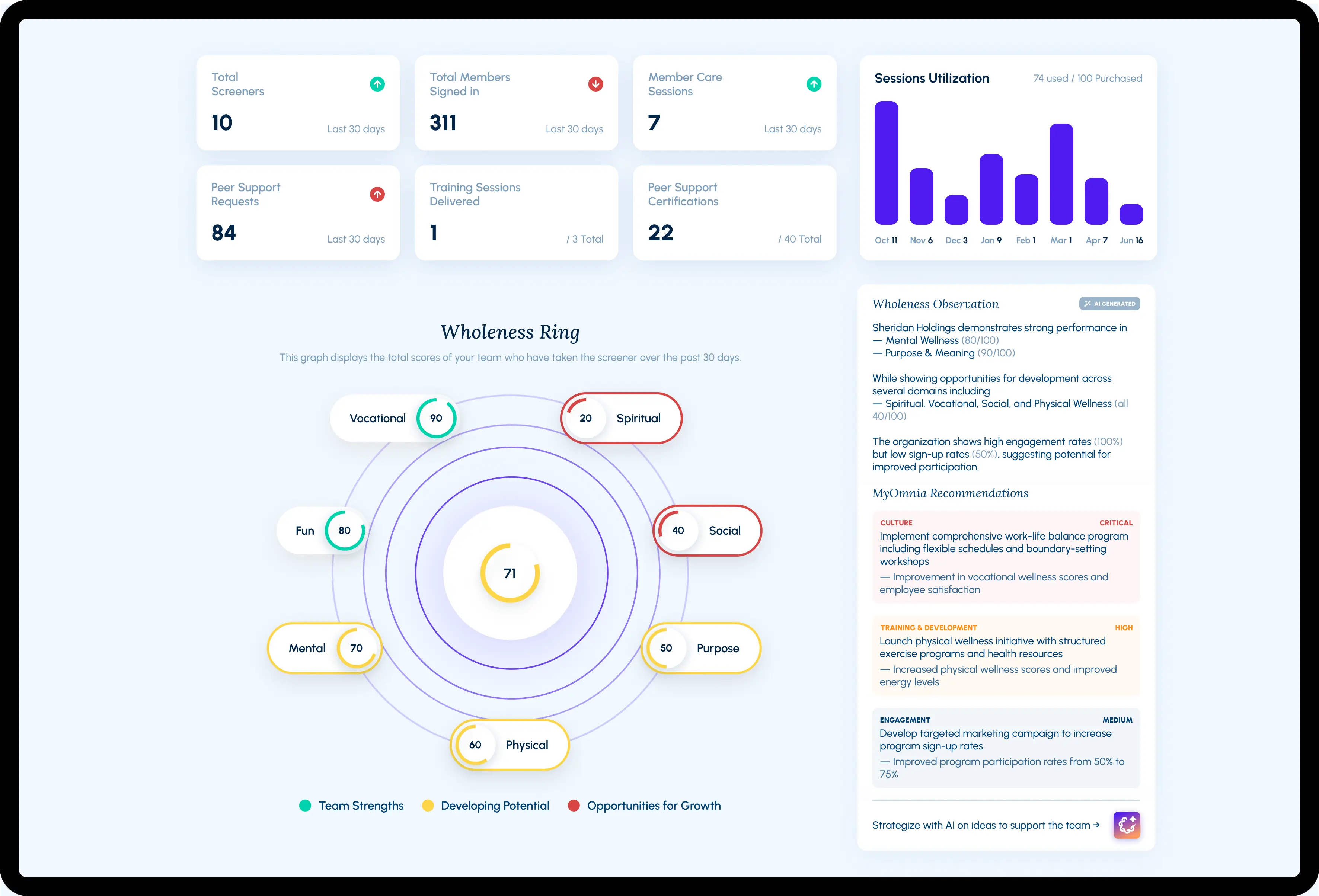
The primary attributes of top-tier employee wellness software comprise mental health solutions, physical well-being tracking, recognizing burnout, and providing management with statistics.
Financial Impact on Businesses
Poor-performance employees generate a great deal of additional expense. In addition to the higher healthcare costs from chronic stress and untreated issues, there will also be increased costs associated with absenteeism, resulting in less than optimal enterprise performance.
A widely cited meta-analysis found that medical costs fall by about $3.27 and absenteeism costs by $2.73 for every dollar invested in wellness programs. Comprehensive programs can deliver up to $6 in savings per dollar spent in well-executed cases.
Operational Impact
The operational consequences can be just as damaging as financial losses.
- Reduced productivity: Stressed out teams will produce more mistakes and be less likely to come up with new ideas.
- High turnover: SHRM estimates replacing an employee costs between 50% and 200% of their annual salary.
- Low engagement: Disengaged employees contribute to low productivity of their team. Engaged teams can be 23% more profitable than disconnected teams.
- Increased errors and safety risks: Stress and fatigue lead to mistakes in all industries.
These issues compound in hybrid environments that make it more challenging to create connections and provide support to each other.
Why Traditional Programs Fail
Traditional wellness initiatives typically resemble one-time initiatives or a generic campaign. They do not offer personalization or a meaningful incentive and are not supported over time.
Most organizations offer little to no means of tracking mental health, do not embed it into workflows, and provide little data or metrics to demonstrate effectiveness. In the absence of data, decision-makers are unable to provide ongoing funding for any given wellness initiative or improve performance.
How Wellness Platforms Solve This
Modern wellness platforms for employers have been designed to address all of the current failures that exist in employer-sponsored wellness programs:
- Continuous engagement provides daily touchpoints that establish habits, rather than solely coincidental or one-off events.
- Personalization provides personalized resources for each employee based on their unique circumstances.
- Data-driven insights provide leadership with clear visibility of the health and wellness trends of the workforce over time, in advance of the occurrence of a crisis.
- Scalability creates an equal opportunity for all employees, regardless of the number of employees being served.
These resources provide a way to have immediate access to support services in a private manner as though they were part of your regular job responsibilities rather than an add-on.

ROI of Employee Wellness Software
The numbers are compelling. A recent survey of 2000 HR leaders shows that 95% of companies that measure ROI report positive returns, and many report at least $2 back for every $1 invested.
Expected outcomes include:
- Lower absenteeism and sick days
- Reduced medical claims (hundreds saved for each engaged employee)
- Increased retention with decreased recruiting expenses
- Higher productivity and engagement
Cost Comparison: Without vs. With a Platform
What to Look for in a Platform
As you evaluate the various options for employee wellness software, leadership teams should focus on the following criteria:
- Ease of integration with existing HRIS, payroll, and benefits systems.
- User-friendly design to encourage employees to use the system easily without requiring IT support.
- Robust analytics to translate wellness data into actionable insights for leaders.
- Privacy and security compliance (HIPAA and GDPR, where applicable) follows appropriate data minimization practices, including encryption, role-based access controls, and aggregate thresholds to protect sensitive employee data.
- Clinical credibility, including access to licensed mental health providers, stepped care models, and clear escalation pathways to provide the right level of support.
- Multilingual and culturally inclusive features for diverse, global workforces.
Responsibility
Employees are responsible for:
- Engage actively in wellness programs.
- Express their concerns and needs in a timely manner.
- Use the tools and resources provided by their employer.
Employers are responsible for:
- Create an environment, culture, and tools that facilitate employee wellness.
- Demonstrate healthy behaviors that serve as examples for employees.
- Removing structural barriers (e.g., heavy workloads, poor management, and lack of psychological safety) that no app can fix alone.
Conclusion
When you invest in a corporate wellness platform, you are putting yourself in a position to protect your greatest asset, your workforce, and receive both measurable financial and operational return on investment. If you ignore corporate wellness, you are increasing your long-term financial risk by adding to costs, losing talent, and decreasing performance.
Leaders who treat employee wellbeing as a performance driver position their organizations for sustainable success.The question is whether your company will act on it.

.png)







.png)