
.png)



If you have ever walked into a room and instinctively scanned every exit, you already know something about hypervigilance. If you have ever found yourself unable to relax even when you are safe at home, you know it too. For some public safety professionals, this is not an occasional feeling. It is a constant companion.
The human brain is wired to survive. When danger appears, the nervous system shifts into high gear. Your heart pounds, your breathing quickens, and your muscles tense. Your focus narrows to the threat at hand, and this response can mean the difference between life and death.
But here is the thing. For officers, firefighters, dispatchers, and paramedics, this survival mechanism is not an occasional visitor. It is a daily companion that follows them home. And that’s where the real challenge comes in.
What Chronic Hypervigilance Really Looks Like
Let us clear something up right away. Hypervigilance is not the same as being alert. Alertness is temporary and helps you focus on a task, but it fades once the situation resolves. Chronic Hypervigilance is a persistent state of heightened sensitivity to potential threats, even when no immediate danger exists. It can occur alongside PTSD, anxiety, burnout, or chronic stress, but it is not a diagnosis in itself.
Think about the dispatcher who replays a traumatic call while making dinner. Think about the officer who cannot sit with their back to a door in a restaurant. Think about the paramedic who startles at a sudden noise and instantly scans for cover.
These responses are driven by an overactive nervous system conditioned to scan for threat . The brain dedicates so much energy to scanning for danger hypervigilance can make it more difficult to rest and regulate emotions. . Research shows public safety personnel experience elevated rates of hyperarousal symptoms tied to cumulative stress (Carleton et al., 2018).
How It Shows Up in Daily Life
Chronic hypervigilance seeps into everyday life, making everyday moments feel uneasy. You might avoid busy locations or have trouble relaxing at family events. You may be checking the exits instinctively in every area you enter without even realizing you are doing so.
Sleep can be elusive as your mind rehashes various possibilities. Each one seems worse than the last and rest is out of the question. The continual vigilance this creates usually takes its toll first in relationships.
Partners might read your attentiveness as emotional remoteness and your children might feel you are mentally elsewhere. Friendships may begin to fade , because it’s easier to remain home than to explain your tiredness. Hypervigilance in the workplace can lead to burnout and inflexible decision-making.
The Connection to Physical Health
The body’s stress response is designed to help us respond to immediate challenges. However, when stress activation remains high over time, it can contribute to wear and tear on the body.
Chronic hypervigilance may be associated with elevated blood pressure and increased cardiovascular strain. Ongoing stress can also contribute to digestive discomfort or worsen existing gastrointestinal symptoms. Some people living with prolonged tension may experience headaches, muscle tightness, or persistent pain.
Sleep is often affected as well. A person may feel tired but still find it difficult to relax because the mind remains alert to possible threats. Disturbed sleep or nightmares can reduce sleep quality and interfere with restorative rest. This may create a difficult cycle: poor sleep can increase emotional reactivity, which may intensify hypervigilance and make restful sleep even harder to achieve (McCanlies et al., 2020).
Why It Is Often Overlooked
One of the most heart-breaking things about chronic hypervigilance is that in the culture of public safety, it is often acceptable. Alertness is a badge of honor. Professional skepticism is expected on every shift, every time. But there’s a fine line between healthy preparedness and debilitating hyperawareness.
That threshold is crossed when hypervigilance begins to impact your quality of life, health or judgment. But many professionals are reluctant to talk about their challenges. They are afraid that admitting the problem will be seen as a weakness or incompetence.
They fear their fitness for duty will be questioned, and they may even doubt themselves. They wonder if they simply lack the resilience required for the job. These fears are understandable but allowing them to dominate prevents people from getting the help they truly need.
The Role of Trauma and Cumulative Stress
Chronic hypervigilance can develop after an especially intense event, a shorter period of repeated exposure, or cumulative exposure to distressing incidents over many years. Each call, scene, or difficult outcome may add to the body’s stress response.
This cumulative stress can contribute to wear and tear from repeated stress activation. Over time, it may become increasingly difficult to manage, even when a person cannot identify one specific incident that changed them.
You may feel as though you are functioning on empty and unable to recharge fully. Cumulative stress may also interact with moral distress, further intensifying hypervigilance. Research has linked cumulative stress with symptoms of both PTSD and moral injury (Papazoglou et al., 2020).
What Meaningful Support Looks Like
Support for chronic hypervigilance should be ongoing and multifaceted rather than limited to a single debriefing or wellness seminar. Effective support may include:
Individual care: Access to mental health professionals who understand public safety work and can provide evidence-based support, including grounding and emotional regulation strategies.
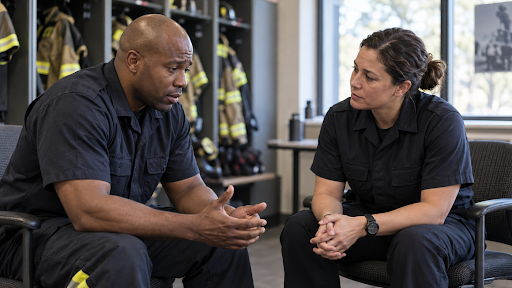
Peer support: Well-designed peer support programs that offer connection, understanding, and validation without replacing professional care.
Organizational changes: Agency-level attention to factors such as staffing, shift length, workload, recovery time, and access to confidential support.
Lifestyle and self-regulation strategies: Supportive practices such as regular movement, balanced nutrition, consistent sleep routines, relaxation techniques, and time for recovery.
When to Seek Professional Help
Chronic hypervigilance exists on a spectrum, and occasional alertness after a difficult shift does not necessarily require clinical intervention. However, seeking support is appropriate when hypervigilance begins to interfere with sleep, relationships, concentration, work, personal safety, or contributes to increased alcohol or substance use.
A trauma-informed mental health professional can assess these experiences and recommend appropriate support. If there are thoughts of self-harm or suicide, or any immediate safety concern, contact emergency services or an appropriate crisis resource without delay.
References
Carleton, R. N., Afifi, T. O., Turner, S., Taillieu, T., LeBouthillier, D. M., Duranceau, S., ... & Asmundson, G. J. (2018). Mental disorder symptoms among public safety personnel in Canada. Canadian Journal of Psychiatry, 63(1), 54-64.
McCanlies, E. C., Gu, J. K., Andrew, M. E., & Violanti, J. M. (2020). The relationship between sleep, obesity, and cardiovascular disease in police officers. Journal of Occupational and Environmental Medicine, 62(7), 486-491.
Papazoglou, K., Blumberg, D. M., Chiongbian, V. B., Tuttle, B. M., Kamkar, K., Chopko, B., Milliard, B., Aukhojee, P., & Koskelainen, M. (2020). The role of moral injury in PTSD among law enforcement officers: A brief report. Frontiers in Psychology, 11, 310.

.png)





.png)