
.png)



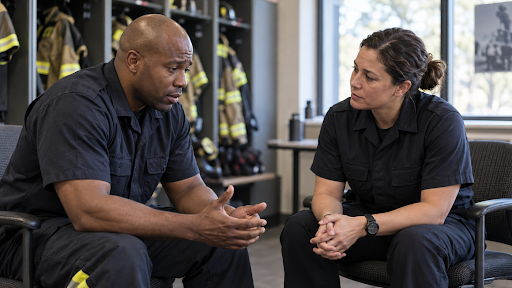
A colleague notices you have gone quiet after a difficult call. They do not corner you, demand an explanation, or offer an easy answer. They simply sit beside you and say, “You don’t seem like yourself. Do you want to talk?”
That moment may look small from the outside. For someone who has been carrying more than they can manage alone, it can create an opening.
During Suicide Prevention Awareness Month, people are often reminded to check on those around them. In first-responder communities, that responsibility carries weight. Firefighters, law enforcement officers, emergency medical professionals, dispatchers, corrections personnel, and other public safety workers regularly encounter trauma, loss, danger, and difficult decisions. Yet the people most likely to recognize when something has changed may not be clinicians. They may be the people working beside them.
What is peer support in suicide prevention?
Peer support is emotional and practical support offered by someone with relevant shared experience. Within a first-responder organization, this may be a trained colleague who understands the job, its culture, and why asking for help can feel difficult.
A peer does not diagnose, investigate, or provide therapy. Their responsibility is to listen without judgment, to take concerns seriously and, when needed, to help the person get to appropriate support. In suicide prevention, peer support can provide a human bridge between unspoken distress and professional treatment.
Evidence for peer-led suicide-prevention initiatives is still emerging, and peer support should not be portrayed as a stand-alone treatment. Research suggests that peer-based interventions can promote connection and engagement, while outcomes differ between programs (Bowersox et al., 2021). Peer support is most effective when paired with professional clinicians, crisis services, clear escalation processes, and organizational leadership.
Why first responders may speak to a peer first
Telling a clinician “I am not doing well” can feel formal or unfamiliar. Telling a trusted colleague “I haven’t slept properly since that call” may feel more possible.
Shared experience can reduce the need to explain every part of the job. A peer may understand why certain calls linger, why a responder is worried about appearing unreliable, or why concerns about confidentiality and career consequences make reaching out difficult. Those concerns should never be dismissed.
A strong peer-support program creates trust by being honest about privacy. Members need to know what remains confidential, what must be shared when there is an immediate safety concern, and how records or conversations are handled. Confidentiality should be explained clearly, not promised in absolute terms when exceptions apply.
What warning signs should a peer notice?
There is no single behaviour that confirms someone is considering suicide. Changes matter most when they are new, escalating, or connected to a painful event, loss, or major life change.
Possible warning signs include:
- Talking about wanting to die, feeling trapped, or being a burden
- Withdrawing from colleagues, friends, or family
- Increased use of alcohol or other substances
- Marked changes in mood, sleep, anger, or agitation
- Giving away valued belongings or saying unusual goodbyes
- Taking dangerous risks or acting with little concern for personal safety
- Looking for ways to die or making a suicide plan
These signs require attention, not assumptions. The National Institute of Mental Health advises taking statements about suicide seriously and connecting the person with help (National Institute of Mental Health [NIMH], 2025).
How to have the conversation
People sometimes avoid asking about suicide because they fear putting the idea into someone’s mind. Asking directly does not increase suicidal thoughts or behaviour. It can give the person permission to answer honestly (NIMH, 2024).
Start with what you have noticed:
“You haven’t seemed like yourself lately, and I’m concerned about you.”
Then ask clearly:
“Are you thinking about suicide?”
If the answer is yes or even “sometimes” stay calm. Listen without judgment. Do not argue, lecture, minimize the pain, or promise secrecy. Ask whether the person is having suicidal thoughts and whether they have a plan, intent, or access to anything they could use to harm themselves. If suicidal thoughts are present especially alongside a plan, intent, or access to lethal means—the peer should promptly involve qualified crisis or mental health support and follow established emergency procedures rather than attempting to assess or manage the risk alone.
Follow established organizational or crisis-response protocols to help reduce access to lethal means when it can be done safely, and connect the person with immediate professional support. Peers should never place themselves at risk or attempt to remove lethal means without appropriate assistance.
NIMH recommends five practical actions: ask, be there, help keep the person safe, help them connect, and follow up (NIMH, 2024). A peer’s responsibility is not to solve the crisis alone. It is to stay present and help bring qualified support into the situation.
Peer support needs organizational support
A suicide-prevention program cannot depend entirely on compassionate employees volunteering their time. Peer supporters need proper training, clear protocols, and access to clinical supervision or consultation, especially after high-risk or suicide-related conversations. They also need opportunities to debrief and receive support, recognizing the emotional weight of carrying these situations.
Organizations must provide training, protected time, defined boundaries, clear procedures for urgent situations, and access to clinical supervision or consultation, especially following high-risk or suicide-related conversations. Peer supporters should also have structured opportunities to debrief and receive support after carrying the emotional weight of these situations.
Leadership also shapes whether people trust the program. If asking for help appears to threaten a person’s reputation or career, employees may remain silent. When leaders speak responsibly about mental health, protect privacy, and make support easy to access, reaching out becomes part of workplace safety, not a sign of professional weakness.
One conversation can open the next door
Peer support is powerful because it begins with an existing human connection. It can turn “Nobody would understand” into “Someone noticed.” It can make the next step calling a counsellor, contacting a crisis service, or speaking with family feel less overwhelming.
Suicide prevention, however, should never rest on one conversation or one person. It requires peers who know how to respond, clinicians who are available, leaders who protect trust, and systems that remain accessible before, during, and after a crisis.
If someone seems different, do not wait for the perfect words. Notice. Ask. Listen. Stay. Then help them connect.
Support should be available before a crisis begins.
Build confidential pathways that connect your team with trained peers and qualified mental health professionals.
Button: Start your 10-day trial
References
Bowersox, N. W., Jagusch, J., Garlick, J., Chen, J. I., & Pfeiffer, P. N. (2021). Peer-based interventions targeting suicide prevention: A scoping review. American Journal of Community Psychology, 68(1–2), 232–248. https://doi.org/10.1002/ajcp.12510
National Institute of Mental Health. (2024). 5 action steps to help someone having thoughts of suicide. https://www.nimh.nih.gov/health/publications/5-action-steps-to-help-someone-having-thoughts-of-suicide
National Institute of Mental Health. (2025). Warning signs of suicide. https://www.nimh.nih.gov/health/publications/warning-signs-of-suicide
988 Suicide & Crisis Lifeline. (n.d.). Get help. https://988lifeline.org/

.png)






.png)