
.png)


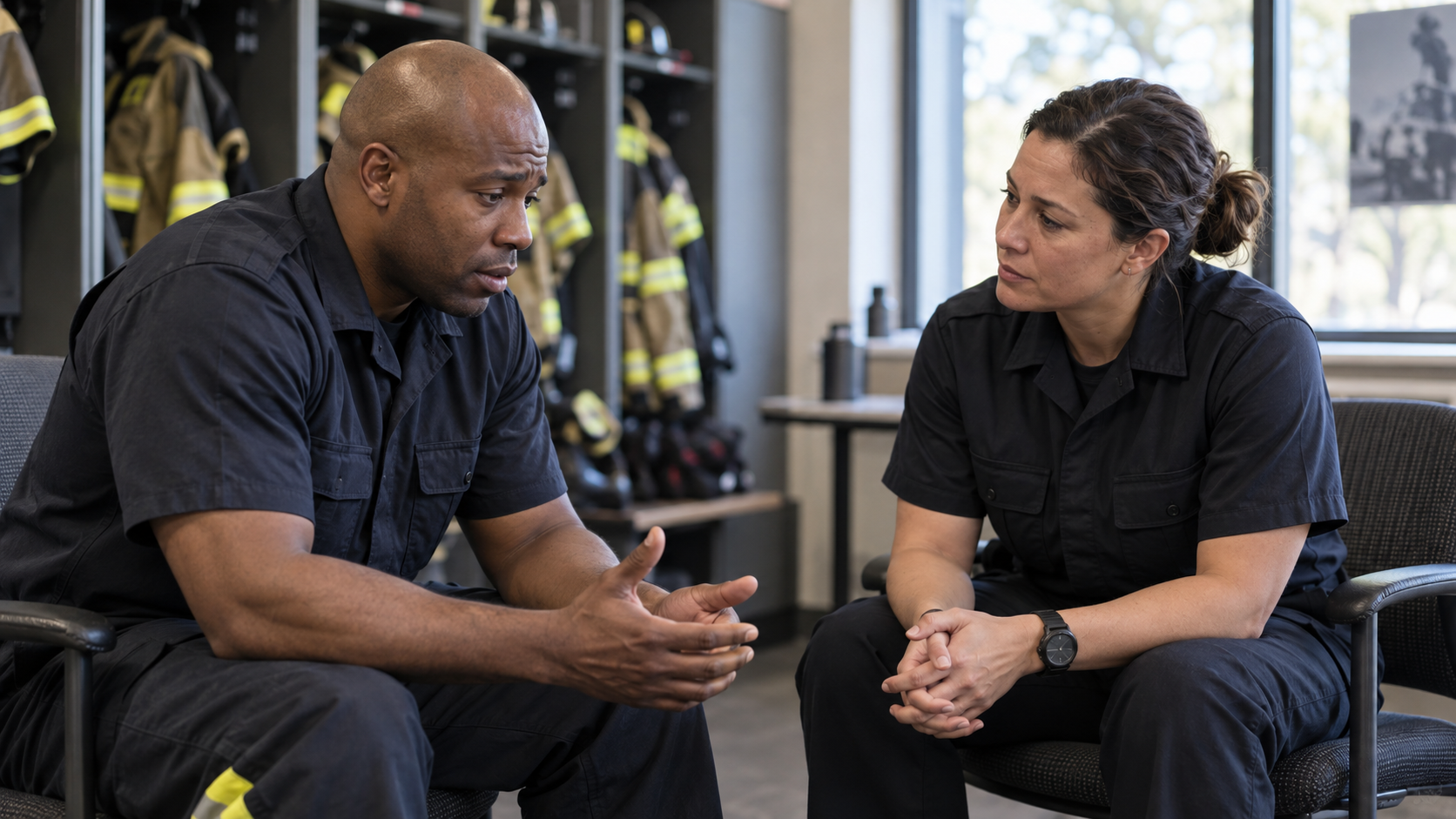
Peer supporters are often the people others call after the worst shift of their career. They listen when a colleague is grieving, struggling at home, questioning a decision, or carrying memories they cannot easily set aside.
But after the conversation ends, where does that emotional weight go?
A strong first responder peer support program must answer that question through its structure not leave each supporter to manage the burden alone. Peer supporter wellness should be built into the program through regular supervision, clear boundaries, planned role rotation, opportunities to step back without stigma, clinical consultation, and confidential access to professional care. Without these protections, the people supporting everyone else may quietly become overwhelmed themselves.
Why Peer Supporters Are Vulnerable to Emotional Overload
Emotional overload occurs when repeated exposure to others’ distress exceeds a peer supporter’s capacity to process and recover from it, leaving them feeling emotionally drained, overwhelmed, or unable to disengage.
Peer supporters occupy a demanding position. They remain active members of the department while also becoming trusted listeners for colleagues experiencing distress. They may hear repeated accounts of fatal incidents, injuries, suicide concerns, family conflict, substance use, or moral distress.
Listening does not affect everyone in the same way. Some conversations may feel manageable, while others may connect with the supporter’s own experiences. Fatigue can also build gradually across many interactions rather than following one major event.
The Substance Abuse and Mental Health Services Administration (SAMHSA, 2024a) identifies overidentification, uncontrolled empathy, and repeated exposure to distress as concerns for people providing support during crises. These experiences may contribute to emotional exhaustion or compassion fatigue when recovery time and organizational safeguards are limited.
This is not evidence that someone is unsuitable for peer support. It is evidence that peer support is real emotional work.
What Does Emotional Overload Look Like?
Emotional overload may not be obvious. A peer supporter may continue working, responding to messages, and helping colleagues while becoming increasingly depleted.
Possible warning signs include:
- Feeling responsible for solving another person’s problems
- Replaying confidential conversations after work
- Becoming unusually irritable, detached, or emotionally numb
- Difficulty sleeping after supporting someone
- Avoiding new peer-support requests
- Feeling guilty about taking time away from the role
- Becoming overly involved in a colleague’s situation
- Using alcohol or other substances to decompress
- Losing patience or emotional availability at home
- Believing that asking for help would undermine credibility
- difficulty maintaining boundaries or feeling pulled into rescuing the colleague
These experiences do not automatically indicate a mental-health condition. They are signals that the supporter may need rest, consultation, reduced exposure, or professional assistance.
How Can Departments Protect Peer Support Teams?
The most effective protection is not simply telling peer supporters to practice self-care. Departments must build support into the structure of the program.
1. Define the Peer Supporter’s Role
Peer supporters listen, provide practical support, share appropriate lived experience, and connect colleagues with additional resources. They are not expected to diagnose, provide therapy, conduct investigations, or remain available around the clock.
The International Association of Chiefs of Police (IACP, n.d.) recommends establishing peer support within a clear organizational structure and securing support from agency leadership. Written policies should explain the peer supporter’s responsibilities, limitations, confidentiality requirements, and escalation procedures.
Clear boundaries protect both participants and supporters.
2. Provide Access to Clinical Consultation
Every peer team should have access to a culturally competent mental-health professional who understands first responder work. Consultation allows peer supporters to ask process-focused questions without unnecessarily disclosing identifying details.
A clinician can help the team:
- Recognize situations beyond the peer role
- Respond appropriately to safety concerns
- Understand emotional reactions following difficult contacts
- Decide when referral is needed
- Review patterns affecting the team as a whole
Clinical consultation should support peer work, not convert confidential peer conversations into treatment records or management reports.
3. Create a Support System Within the Team
Peer supporters need peers too. Regular team check-ins can give members a place to discuss how the role is affecting them while continuing to protect the identity and privacy of the people they support.
These check-ins should not become informal case discussions filled with unnecessary details. The focus should remain on the supporter:
“That conversation stayed with me, and I need help resetting.”
The goal is not to disclose a colleague’s story. It is to prevent the peer supporter from carrying it alone.
4. Use Rotation and Recovery Periods
The same dependable people are often called repeatedly because others trust them. Over time, that reliability can become overuse.
Programs should track workload without tracking the confidential content of conversations. Teams can rotate on-call responsibilities, distribute high-intensity contacts, and allow members to become temporarily unavailable without guilt or penalty.
After a particularly difficult interaction, a peer supporter may need time to decompress, speak with the clinical consultant, or transfer availability to another trained team member.
5. Train for Boundaries, Not Just Crisis Response
Initial training is not enough. Peer supporters need continuing education in active listening, suicide-safety procedures, confidentiality, referral, cultural awareness, and role boundaries. Training should also establish clear documentation boundaries, including what must be recorded, what should never be documented, who can access records, and how confidentiality is protected.
Peer supporters must also learn to recognize their own stress responses and personal limits. SAMHSA (2024b) recommends combining organizational measures such as defined responsibilities, supervision, structured peer support, and clear procedures with individual stress-management practices.
A peer supporter who recognizes personal limits early, seeks consultation, or transfers responsibility when needed is protecting both the program and the people it serves not failing them.
6. Make Stepping Back Safe
Peer supporters should be able to pause or leave the role without embarrassment. Life circumstances change. A team member may be experiencing grief, relationship difficulties, sleep disruption, a personal crisis, or cumulative occupational stress.
Departments should establish a private, respectful process for temporary leave and return. No peer supporter should feel that protecting their health will damage their career or disappoint the team.
Self-Care Cannot Replace Organizational Care
Sleep, physical activity, supportive relationships, and time away from the role can help peer supporters recover. SAMHSA (2024c) includes adequate sleep, healthy eating, physical activity, and active relaxation among core resilience practices for crisis workers.
However, these practices cannot compensate for an understaffed team, constant availability, unclear escalation procedures, or lack of clinical guidance. When emotional overload develops because the system relies too heavily on a few people, the system must change.
Peer supporter wellness is a shared organizational responsibility.
Supporting the People Who Hold Space for Others
A peer support program is only sustainable when care moves in both directions. Peer supporters need permission to set limits, consult professionals, share responsibility, and receive the same confidential support they offer their colleagues.
Protecting them strengthens trust in the entire program. It also communicates something important across the department: no one, including the helper, is expected to carry difficult experiences alone.
References
International Association of Chiefs of Police. (n.d.). Peer support guidelines. https://www.theiacp.org/resources/peer-support-guidelines
Substance Abuse and Mental Health Services Administration. (2024a, February 29). Disaster responder stress management. https://www.samhsa.gov/technical-assistance/dtac/disaster-response-toolkit/program-admin/disaster-responder-stress-management
Substance Abuse and Mental Health Services Administration. (2024b, February 29). Organizational and individual stress management. https://www.samhsa.gov/technical-assistance/dtac/disaster-response-toolkit/program-admin/organizational-individual-stress-management
Substance Abuse and Mental Health Services Administration. (2024c, October 17). Compassion fatigue and self-care resources for crisis counselors. https://www.samhsa.gov/technical-assistance/dtac/ccp/self-care

.png)





.png)