
.png)



When you are in a relationship with a first responder, often the emotional toll of the job is shared. Police officers, firefighters, paramedics, emergency medical technicians and dispatchers frequently must deal with danger, trauma, unpredictable schedules and intense responsibility. But the shift is finally over, even if the emotional fallout is going home with them.
As a partner you may be listening, rearranging family plans, doing the household chores and being alert for when something is wrong. Your support is important, but not at the expense of your own mental health.
Helping a first responder doesn’t mean carrying the whole load. A lasting partnership has to protect both sides.
Understand How the Job Can Affect Home Life
First responder job poses problems that go beyond exposure to horrific occurrences. Shift work, missed family occasions, sleep disruption, staffing shortages, public scrutiny, job pressure and worry for personal safety can impair family life.
Research with public safety families has highlighted common challenges such as inconsistent scheduling, uneven distribution of household chores, emotional isolation, and difficulty shifting between work and family roles (Cox et al., 2022).
Your companion may be quiet, irritated, restless, emotionally distant or particularly alert after a hard workday. These reactions may not automatically suggest they have post-traumatic stress disorder. Sometimes folks just need time to recover from a stressful experience. But if it doesn’t go better, or starts to disrupt your day-to-day life, you may need some extra help.
Partners may also experience worry, emotional weariness, decreased well-being, and signs of secondary traumatic stress (Sharp et al., 2022). Knowing this influence is not to detract focus from first responders. It means recognizing that their families deserve help as well.
Listen Without Trying to Fix Everything
When someone you love is struggling, it is natural to search for solutions. You may ask repeated questions, offer advice, or take responsibility for improving their mood. Unfortunately, this can leave both people feeling frustrated.
Instead, begin with a simple observation:
“You seem quieter than usual. You don’t have to talk right now, but I’m here when you’re ready.”
This approach communicates concern without demanding disclosure. Some first responders avoid discussing difficult calls because they want to protect their families from disturbing details. Others may worry about appearing weak or facing professional consequences if they admit they are struggling. Stigma and career concerns remain significant barriers to seeking mental health care among first responders (Jones et al., 2020).
Respecting privacy does not mean ignoring behaviour that affects the relationship. Your partner may not want to discuss what happened, but you can still talk about the anger, withdrawal, drinking, or tension you are experiencing at home.
Create a Routine for Reconnecting After Work
A first responder may arrive home while their mind and body are still operating in emergency mode. Expecting immediate conversation or family engagement may create tension, especially after a demanding shift.
Discuss a transition routine when both of you are calm. Your plan could include:
- Twenty minutes of quiet time after work
- A shower, walk, or meal before discussing the day
- A short message indicating that the shift was difficult
- An agreed time to reconnect
- A different plan when children or household needs require immediate attention
Decompression should help your partner return to family life. It should not become an excuse for remaining emotionally unavailable all evening.
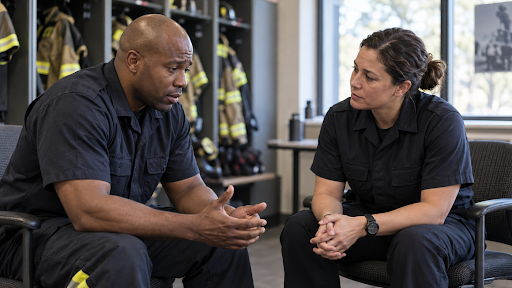
Ask directly:
“What helps you settle after work, and how can we make sure we still reconnect afterward?”
A clear agreement prevents one person from feeling pressured and the other from feeling abandoned.
Set Limits on What You Can Carry
You do not need to hear graphic details to be supportive. Repeated exposure to descriptions of violence, injury, or death can be distressing for partners.
You can say:
“I want to understand how the experience affected you, but graphic details stay with me. Can we talk about how you are feeling instead?”
This is a boundary, not rejection.
You also cannot be your partner’s only source of emotional support. Trusted peers, culturally informed clinicians, chaplains, employee assistance programs, and first responder support groups may provide forms of understanding that a partner cannot offer alone. Research suggests that trusted people can help responders recognize changes and connect with care, but supporters also need information and boundaries to protect their own well-being (Tjin et al., 2022).
Your role is to care and encourage appropriate help not to become a therapist.
Protect Your Own Identity and Routine
Burnout often develops quietly. You may stop seeing friends because your partner might need you. You may cancel activities because their schedule is unpredictable. You may check their mood before deciding whether you are allowed to relax.
Eventually, your life can become organized entirely around their job.
Protect time for:
- Friendships and social support
- Regular sleep and physical activity
- Hobbies and personal interests
- Individual counselling when needed
- Time when you are not managing another person’s emotions
- Goals that are unrelated to your partner’s career
Maintaining your own life is not selfish. Social connection, open communication, and access to family-focused support can strengthen resilience in public safety families (Cox et al., 2022).
Recognize Your Signs of Burnout
You may be approaching burnout if you:
- Constantly monitor your partner’s mood
- Feel responsible for preventing their distress
- Become anxious before they return home
- Feel angry toward the job or department
- Struggle to sleep or relax
- Withdraw from friends and activities
- Carry most household or parenting responsibilities
- Feel guilty whenever you prioritize yourself
- Believe you must always remain strong
These signs do not mean you have failed. They suggest that the current arrangement may no longer be sustainable.
Ask yourself: What am I carrying that needs to be shared, changed, or supported by someone else?
Establish Clear and Respectful Boundaries
Trauma and occupational stress may explain certain behaviours, but they do not excuse intimidation, threats, aggression, or repeated emotional harm.
Healthy boundaries may sound like:
- “I will not continue a conversation while I am being shouted at.”
- “I need one evening each week for my own plans.”
- “I can support you, but I cannot be the only person you talk to.”
- “We need a fair plan for parenting and household responsibilities.”
- “If alcohol continues to affect our relationship, we need professional support.”
A boundary explains what you need and how you will respond. It is not a punishment or an attempt to control your partner.
Know When Professional Help Is Needed
Encourage professional support when changes persist, worsen, or interfere with relationships and daily functioning. Concerning signs may include:
- Nightmares, flashbacks, or serious sleep problems
- Increasing isolation or emotional numbness
- Aggressive or reckless behaviour
- Heavy alcohol or drug use
- Expressions of hopelessness or worthlessness
- Talk of suicide, death, or having no reason to live
If your partner may harm themselves or someone else, do not promise secrecy. Contact local emergency services or a crisis resource. In the United States, call or text 988 for the Suicide & Crisis Lifeline.
Support Should Work Both Ways
First responder families often demonstrate pride, commitment, and resilience. However, resilience does not mean silently tolerating unlimited stress.
You can listen without absorbing every painful detail. You can offer patience while maintaining boundaries. You can encourage professional help without accepting responsibility for every decision your partner makes.
The goal is not to become endlessly stronger for someone else. It is to create a relationship in which both people can ask for support, protect their well-being, and remain emotionally connected.
References
Cox, M., Norris, D., Cramm, H., Richmond, R., & Anderson, G. S. (2022). Public safety personnel family resilience: A narrative review. International Journal of Environmental Research and Public Health, 19(9), 5224. https://doi.org/10.3390/ijerph19095224
Jones, S., Agud, K., & McSweeney, J. (2020). Barriers and facilitators to seeking mental health care among first responders: “Removing the darkness.” Journal of the American Psychiatric Nurses Association, 26(1), 43–54. https://doi.org/10.1177/1078390319871997
Sharp, M. L., Solomon, N., Harrison, V., Gribble, R., Cramm, H., Pike, G., & Fear, N. T. (2022). The mental health and wellbeing of spouses, partners and children of emergency responders: A systematic review. PLOS ONE, 17(6), e0269659. https://doi.org/10.1371/journal.pone.0269659
Tjin, A., Bos, M. G. N., Pernet, D., & de Boer, M. R. (2022). Turning to “trusted others”: A narrative review of providing social support to first responders. International Journal of Environmental Research and Public Health, 19(24), 16778. https://doi.org/10.3390/ijerph192416778

.png)





.png)