
.png)



Police officers are trained to stay composed when situations become uncertain or dangerous. That discipline protects the public and helps officers make sound decisions under pressure. Inside a department, however, the same expectation can become harmful when composure is mistaken for silence. An officer may be struggling with poor sleep, intrusive memories, irritability, grief, anxiety, or exhaustion while still reporting for duty and completing every required task. If asking for support is treated as weakness, that officer learns to hide the problem rather than address it.
Research has repeatedly identified stigma, concerns about confidentiality, fear of career consequences, and doubts about whether clinicians understand police work as barriers to care. Burns and Buchanan (2020) found that police culture can influence decisions about seeking help, particularly when officers fear being viewed as weak or unfit for duty. Departmental culture therefore affects whether support feels like a safe resource or a professional risk.
Culture Is Communicated Through Daily Behaviour
Culture is not limited to mission statements or formal values. It is created through ordinary conversations, supervisor reactions, promotion decisions, and the stories officers tell one another. A department may publicly encourage wellness while informally rewarding people who never acknowledge strain. It may advertise confidential counselling while allowing jokes about officers who attend therapy.
This stigma has practical consequences. Grupe et al. (2023) found that greater mental health stigma among police employees was associated with weaker intentions to seek help. A department cannot assume that available services feel safe enough to use.
Leaders should examine what happens after an officer discloses a concern. Is the first response curiosity and support or suspicion and administrative control? Are decisions explained clearly? Is the officer included in planning? A respectful response can preserve dignity even when a temporary duty change is necessary. A careless response can discourage an entire unit from speaking honestly. One poorly handled disclosure can quickly become a story that shapes whether others trust the system or choose to stay silent.
Fear of Career Consequences Is Not Irrational
Officers may worry that asking for help will affect firearm access, fitness evaluations, specialty assignments, promotion opportunities, or the confidence of their team. Leaders sometimes dismiss these concerns by saying that services are confidential. But reassurance is not enough when policies are vague or past experiences suggest otherwise.
Confidential care and fitness-for-duty evaluations serve different purposes. Confidential care is sought for treatment and support, with clinical information generally protected except when disclosure is legally or ethically required. A fitness-for-duty evaluation is typically requested by the employer to determine whether an officer can safely perform essential job duties, with different privacy boundaries and reporting requirements. Clearly explaining this distinction before an officer seeks help is essential to building trust..
The United States Department of Justice (2020) reported that officers can fear job loss or other professional consequences when seeking mental health support. The report emphasized the importance of peer assistance, behavioural health partnerships, training, and clear confidentiality protections. Departments should explain who can access information, what remains confidential, which safety exceptions apply, and how clinical care is separated from fitness for duty decisions. Officers should receive this information before a crisis occurs.
Supervisors Shape the First Response
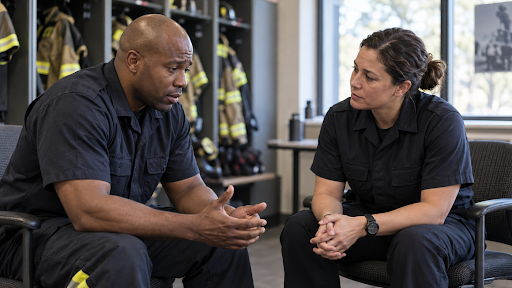
An officer who is struggling will often test the environment before making a direct request. They may mention poor sleep, family tension, a difficult call, or feeling unlike themselves. The supervisor’s response may determine whether the conversation continues.
Supervisors do not need to become therapists. They need to listen without judgment, recognize changes in behaviour, know available resources, and respond appropriately when safety is a concern. A dismissive phrase can close the door. A calm statement such as, “You do not have to manage this alone. Let us look at the support available,” can make help feel acceptable.
Leadership behaviour is not simply private chats. When top executives speak freely about stress, counselling, loss or recovery, they challenge the notion that competence is silent about emotion. When executives attend, participate and repeat the message of mental health training, it adds credibility. Knaak et al. (2019) showed the success of workplace mental health training in police organizations was dependent in part on implementation, leadership support and larger culture change.
Peer Support Must Be Trusted and Well Designed
Many officers like to speak first with someone who knows police work. A qualified peer can spot workplace stress, provide practical help and link a colleague to clinical care. Peer support can help people feel less isolated and get help sooner. Police peer assistance may support help-seeking and connection when programs are well designed, confidential, and linked to clinical care. (Milliard, 2020).
A peer program will fail if officers doubt its confidentiality or view its members as extensions of management. Departments need written policies, careful selection, quality training, clinical consultation, defined boundaries, and clear procedures for urgent situations. Peer supporters should never be expected to diagnose or replace licensed professionals.
Signs That Your Culture May Be Blocking Help
A department should look beyond program enrolment and ask harder questions. Officers may not feel safe seeking help if mental health is discussed only after a crisis, counselling is routinely mocked, confidentiality rules are unclear, supervisors receive little training, or employees believe care will damage their careers. Low use of services does not necessarily mean low need. It may mean low trust.
Anonymous surveys, confidential interviews, and program assessments can highlight the gap between policy and experience. Leaders should ask: Do officers know where to go? Do they trust the providers that are available? Do they understand confidentiality? Do they believe they can get care without retaliation? The results should lead to visible action. Asking for feedback without visible follow-through can increase cynicism.
Building a Culture Where Help Is Normal
Culture changes when healthy behaviour becomes ordinary. Departments can begin by presenting mental health care as part of professional readiness. Routine wellness visits can make support familiar before distress becomes severe. Clear confidentiality policies can reduce uncertainty. Trained supervisors can respond earlier. Credible peer teams can provide connection while external clinicians offer privacy and specialized care.
Departments should also examine working conditions. Counselling cannot solve chronic understaffing, excessive overtime, inconsistent discipline, poor leadership, or repeated exposure without adequate recovery time. Organizational stressors can contribute to distress and weaken trust in wellness messaging. Support must include both individual care and responsible organizational practice.
The goal is to create a fair process in which seeking care is viewed as responsible. Officers are more likely to speak before a concern becomes a crisis when they believe they will be treated with dignity.
Culture is measured when someone says, “I need help.” The response that follows tells every officer what the department truly values. A supportive department does not wait for people to break. It makes early help visible, credible, confidential, and safe.
Turn Support into a Department Standard
Officers need a trusted path to care before stress becomes a crisis. Effective support begins with confidentiality, credible peer connection, informed leadership, and timely access to professional care.
References
Burns, C., & Buchanan, M. (2020). Factors that influence the decision to seek help in a police population. International Journal of Environmental Research and Public Health, 17(18), 6891. https://doi.org/10.3390/ijerph17186891
Grupe, D. W., Stoller, J. L., Alonso, C., McGehee, C., Smith, C., Mumford, E. A., & Rosenkranz, M. A. (2023). Mental health stigma and help seeking intentions in police employees. Frontiers in Psychology, 14, Article 1039841. https://doi.org/10.3389/fpsyg.2023.1039841
Knaak, S., Luong, D., McLean, R., Szeto, A., & Dobson, K. S. (2019). Implementation, uptake, and culture change: Results of a key informant study of a workplace mental health training program in police organizations in Canada. The Canadian Journal of Psychiatry, 64(Supplement 1), 30S to 38S. https://doi.org/10.1177/0706743719842565
Milliard, B. (2020). Utilization and impact of peer support programs on police officers’ mental health. Frontiers in Psychology, 11, 1686. https://doi.org/10.3389/fpsyg.2020.01686
United States Department of Justice, Office of Community Oriented Policing Services. (2020). Law enforcement officer suicide: 2020 report to Congress. https://cops.usdoj.gov/RIC/Publications/cops-p429-pub.pdf

.png)





.png)