
.png)



A call comes in. Information is incomplete, emotions are running high, and someone may be in danger. An officer has seconds to decide what to do.
Should they move forward or wait for backup? Use force or continue trying to de-escalate? Follow an order that feels wrong or challenge it? Protect one person when doing so may place another at risk?
From the outside, these moments are often reviewed slowly with reports, recordings, policies, and time to consider every alternative. The officer did not have that luxury. They had to decide while standing inside the uncertainty.
Training can prepare officers to assess threats and follow procedure. It cannot always protect them from the emotional weight of choosing between options when none feels entirely right.
When Every Option Has a Cost
Some law enforcement decisions are difficult because the facts are unclear. Others are difficult because every available choice carries the possibility of harm.
An officer may arrive at a domestic violence call involving frightened children, respond to someone experiencing a mental health crisis, notify a family that a loved one has died, or decide whether force is necessary during a rapidly escalating encounter. Even when the response is lawful and consistent with policy, the outcome may still be painful.
Afterward, the questions can become relentless:
- Did I miss something?
- Could I have slowed the situation down?
- Did my decision make things worse?
- What if I had chosen differently?
- How will this affect the family involved?
- Will my agency and community understand what happened?
Such introspection is not usually a sign of weakness or poor judgment. It could be a sign of the officer’s compassion, sense of duty and commitment to protecting others. The trouble comes when reflection develops into perpetual guilt, humiliation, rage or self-punishment.
Understanding Moral Distress and Moral Injury
Not every tough decision leads to trauma, not every officer who doubts an occurrence develops a mental health condition. But certain interactions can result in what experts call moral distress.
Moral discomfort is when you know or think you know what the right thing to do is, but you cannot do it because of policy, lack of resources, conflicting directives, safety, or situations outside your control. Police officers may also experience distress when they have acted against their values or seen conduct that they considered inappropriate.
The event may be called a moral injury if the emotional effects are severe and persistent.Moral injury is not currently a standalone psychiatric diagnosis. It describes psychological, social, or spiritual distress that can follow events perceived as violations of deeply held moral values. (Blumberg et al., 2020).
Potentially morally injurious dilemmas in law enforcement could include failing to save someone, making a decision that has unintended repercussions, seeing misconduct, following a distressing command, or feeling betrayed by leadership in a significant incident (Lentz et al., 2021).
Moral Injury Is Not the Same as PTSD
Moral injury and post-traumatic stress disorder can overlap, but they are not interchangeable.
PTSD is associated with symptoms such as intrusive memories, avoidance, changes in mood and thinking, and heightened reactivity following exposure to trauma. Moral injury is more closely centered on guilt, shame, anger, betrayal, loss of trust, or conflict with one’s identity and values.
An officer may experience one, both, or neither. Research involving trauma-exposed police officers has identified different patterns of moral injury appraisals and PTSD symptoms, reinforcing the importance of assessing them separately rather than assuming every painful reaction is PTSD (Mooren et al., 2024).
This distinction matters. An officer may not be afraid of remembering an incident but may feel unable to forgive themselves. Another may feel intense anger toward a colleague, supervisor, agency, or system. Someone else may begin questioning whether they are still the person they believed themselves to be.
Those concerns require more than being told to “move on.”
How the Emotional Cost May Appear
The impact of an impossible decision may surface immediately, or it may build over time. Possible signs include:
- Repeatedly replaying an incident
- Persistent guilt, shame, anger, or regret
- Becoming emotionally distant from family or colleagues
- Irritability or reduced patience
- Sleep difficulties or nightmares
- Loss of trust in leadership or the justice system
- Avoiding people, places, or duties connected to the event
- Increased alcohol or substance use
- Feeling undeserving of support or forgiveness
- Questioning one’s identity, purpose, or ability to continue serving
These experiences do not automatically indicate moral injury, PTSD, or another disorder. The more important questions are whether they persist, worsen, or begin interfering with relationships, sleep, judgment, work, or personal safety.
Silence Can Deepen the Harm
Law enforcement culture often rewards control under pressure. That strength is valuable during an emergency, but it can become a barrier afterward.
An officer may worry that admitting distress will affect their assignment, reputation, promotion, or fitness-for-duty status. They may also believe that colleagues will not understand why an incident continues to bother them especially if their actions were cleared by the agency.
Administrative clearance, however, does not always bring emotional resolution.
Research has connected potentially morally injurious experiences among police officers with PTSD symptoms, compassion fatigue, and emotional distress (Papazoglou et al., 2020). Support should therefore address more than whether an officer followed policy. It should also make room for what the event meant to the officer.
What Meaningful Support Looks Like
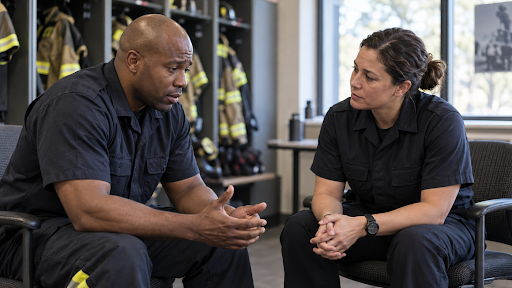
Effective support begins with psychological safety. Officers need confidential opportunities to discuss difficult decisions without being automatically judged, diagnosed, or treated as incapable of performing their duties.
Helpful options may include:
- Access to culturally competent mental health professionals
- Trained peer-support teams with clear confidentiality boundaries
- Chaplaincy or spiritual care when aligned with the officer’s beliefs
- Voluntary wellness check-ins after critical incidents
- Leadership follow-up that continues beyond the initial debrief
- Adequate recovery time following high-impact events
- Family education about common stress responses
- Structured spaces for reflection, accountability, and moral repair
No single response will work for everyone. Some officers may benefit from peer connection, while others need individual therapy or support grounded in their personal values. The goal is not to erase responsibility or justify every action. It is to help officers process what happened honestly, reconnect with their values, and move forward without carrying the burden alone.
Support Those Who Make the Hardest Calls
Officers are expected to make life-changing decisions under conditions most people will never face. They deserve support that recognizes not only operational stress, but also the emotional and moral weight of the work.
References
Blumberg, D. M., Papazoglou, K., & Schlosser, M. D. (2020). Organizational solutions to the moral risks of policing. International Journal of Environmental Research and Public Health, 17(20), 7461. https://doi.org/10.3390/ijerph17207461
Lentz, L. M., Smith-MacDonald, L., Malloy, D., Carleton, R. N., & Brémault-Phillips, S. (2021). Compromised conscience: A scoping review of moral injury among firefighters, paramedics, and police officers. Frontiers in Psychology, 12, 639781. https://doi.org/10.3389/fpsyg.2021.639781
Mooren, N., de la Rie, S. M., & Boelen, P. A. (2024). Moral injury appraisals and posttraumatic stress symptoms in trauma-exposed police officers: A latent class analysis. European Journal of Psychotraumatology, 15(1), 2365030. https://doi.org/10.1080/20008066.2024.2365030
Papazoglou, K., Blumberg, D. M., Chiongbian, V. B., Tuttle, B. M., Kamkar, K., Chopko, B., Milliard, B., Aukhojee, P., & Koskelainen, M. (2020). The role of moral injury in PTSD among law enforcement officers: A brief report. Frontiers in Psychology, 11, 310. https://doi.org/10.3389/fpsyg.2020.00310

.png)





.png)