
.png)



The shift is over, but the body has not received the message.
The call keeps replaying. Sleep feels far away. Talking about what happened feels even harder. A drink may seem like the fastest way to quiet the noise, loosen the tension, or create some distance from the day.
For many first responders, drinking does not begin as an obvious problem. It may start as a way to unwind with the crew, fall asleep after a difficult shift, or stop thinking about an incident. The concern is not simply whether someone drinks. It is whether alcohol is becoming the primary way they cope.
Why Alcohol Can Become a Coping Strategy
Law enforcement officers, firefighters, paramedics, emergency medical personnel, dispatchers, and other first responders routinely work under conditions that most people encounter only during the worst moments of their lives.
They may witness serious injuries, death, violence, child abuse, suicide, or intense human suffering. Between critical incidents, they still face disrupted sleep, long shifts, public scrutiny, staffing pressures, and the expectation that they remain composed regardless of what they have just experienced.
Alcohol can offer temporary relief. It can make a person less awake, less aware and more emotionally distant for a few hours. That temporary effect is what makes drinking feel useful, at least until alternative types of assistance are accessible or safe.
The problem is that a temporary fix doesn’t go to the root of the tension. Alcohol can cause sleep disturbances, anxiety, depressed mood, relational problems, impaired judgment and more emotional instability over time. Moreover, studies among first responders have indicated a link between intrusive PTSD symptoms and higher alcohol usage (Kaufman et al., 2024).
When Does Drinking Become a Concern?
There is no single amount or moment that tells the whole story. A person does not need to drink every day, reach a crisis, or lose their job before alcohol deserves attention.
The pattern and purpose of drinking matter. Warning signs may include:
- Drinking mainly to sleep, calm down, forget, or feel emotionally numb
- Needing more alcohol than before to achieve the same effect
- Drinking more or for longer than intended
- Trying to reduce drinking but being unable to maintain the change
- Hiding or minimizing how much alcohol is being consumed
- Experiencing memory gaps or blackouts
- Becoming irritable or restless when alcohol is unavailable
- Missing family, work, or personal responsibilities
- Driving or taking other risks after drinking
- Continuing to drink despite problems with health, mood, work, or relationships
- Feeling unable to manage a difficult shift or memory without alcohol
These signs do not prove that someone has alcohol use disorder. That determination requires an appropriate clinical assessment. They do indicate that an honest conversation may be needed.
Alcohol use disorder is a medical condition involving difficulty controlling alcohol use despite harmful personal, occupational, social, or health consequences. It can range from mild to severe, and effective treatment is available (National Institute on Alcohol Abuse and Alcoholism [NIAAA], n.d.-a).
Why First Responders May Stay Silent
A first responder may recognize that their drinking has changed and still hesitate to seek help.
They may fear losing their position, firearm, certification, colleagues’ trust, or eligibility for promotion. Some worry that asking for support will trigger an investigation or fitness-for-duty evaluation. Others have spent years being the person who arrives when someone else is in trouble. Admitting that they now need help can feel unfamiliar and exposing.
That silence can allow a manageable concern to become more serious.
Departments can reduce this barrier by clearly explaining what support is confidential, what information may be disclosed, and under what limited circumstances confidentiality must be broken. Vague promises of privacy are not enough. First responders need accurate information before they can make an informed decision about seeking help.
Recovery Is Not a Test of Willpower
Problematic alcohol use is sometimes treated as a failure of discipline. That view overlooks how stress, trauma, sleep disruption, learned habits, mental health symptoms, and workplace culture can interact.
Recovery is not simply a matter of “being stronger.” It involves understanding what alcohol has been doing for the person and developing safer, more sustainable ways to meet those needs.
Depending on the individual, support may involve:
- A confidential assessment by a licensed professional
- Therapy that addresses both alcohol use and occupational stress
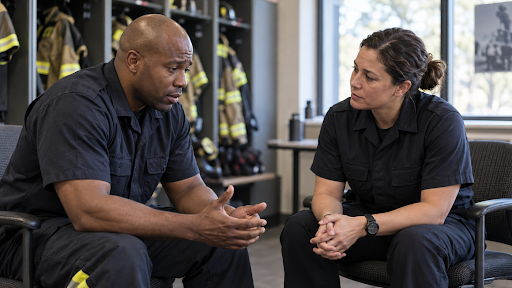
- Peer support from someone familiar with first responder culture
- Medical care for withdrawal symptoms or other health concerns
- Medications that can help reduce drinking or support recovery
- Mutual-support or recovery groups
- Sleep treatment and healthier post-shift routines
- Family education and relationship support
- Ongoing follow-up after the immediate concern has improved
Treatment does not look the same for everyone. Some people receive outpatient support while continuing to work. Others may need more intensive or medically supervised care. Evidence-based options include behavioural treatment, medication, and mutual-support programs (NIAAA, n.d.-a).
A first responder who has been drinking heavily for a prolonged period should not suddenly stop without medical guidance. Alcohol withdrawal can be dangerous and, in some cases, life-threatening (NIAAA, n.d.-b).
What Departments Can Do
Support cannot depend entirely on an individual reaching a breaking point. Departments shape whether asking for help feels possible.
A meaningful response involves discreet avenues for support, trained peer teams, access to culturally competent specialists, routine wellness check-ins, education for supervisors, and clear procedures that separate voluntary help-seeking from impairment while on duty.
Leaders also influence culture through everyday language. When alcohol misuse is treated as a joke, weakness, or disciplinary issue alone, people learn to hide it. When leaders discuss recovery with respect and make support visible before a crisis, seeking help becomes safer.
Recovery Can Begin Before Everything Falls Apart
A person does not have to lose a career, marriage, friendship, or sense of self before making a change. Concern is enough reason to pause and speak with someone.
Recovery may include setbacks, adjustments, and more than one attempt. That does not make it a failure. Many people with alcohol-related problems reduce their drinking or recover with appropriate care, and improvement can extend beyond alcohol use to sleep, relationships, health, and quality of life (NIAAA, n.d.-b).
Asking for help is not stepping away from the mission. It is protecting the person carrying it.
References
Kaufman, C. C., Vujanovic, A. A., Murphy, J. G., & Rosmarin, D. H. (2024). The association between PTSD symptom clusters and religion/spirituality with alcohol use among first responders. Journal of Psychiatric Research, 176, 136–143. https://doi.org/10.1016/j.jpsychires.2024.06.015
National Institute on Alcohol Abuse and Alcoholism. (n.d.-a). Understanding alcohol use disorder. https://www.niaaa.nih.gov/publications/brochures-and-fact-sheets/understanding-alcohol-use-disorder
National Institute on Alcohol Abuse and Alcoholism. (n.d.-b). Treatment for alcohol problems: Finding and getting help. https://www.niaaa.nih.gov/publications/brochures-and-fact-sheets/treatment-alcohol-problems-finding-and-getting-help

.png)





.png)