
.png)


Burnout is no longer a quiet issue discussed behind closed HR meetings. It’s showing up in performance reviews, sick leaves, exit interviews, and most importantly in people’s lives. This visibility aligns with decades of occupational health research showing that burnout manifests behaviorally long before employees seek formal psychological care. New research from Moodle shows that 66% of American employees are experiencing some sort of worker burnout in 2025.
Burnout is no longer limited to traditionally high-stress sectors like healthcare or emergency services. Burned-out employees are now found across corporate offices, tech startups, education, finance, and remote-first organizations. The common thread is not the job title but the environment.
At MyOmnia Health, we work with organizations that are actively asking a critical question: How do we support our people before burnout turns into breakdown, disengagement, or resignation? One of the most effective and often misunderstood answers lies in choosing the right EAP vendor.

What Is Worker Burnout?
The World Health Organization officially defines worker burnout as an occupational phenomenon resulting from chronic workplace stress that has not been successfully managed (WHO, 2019).
It is characterized by three core dimensions:
- Emotional exhaustion: feeling drained, overwhelmed, and unable to cope
- Mental distance or cynicism: disengagement, detachment, or negativity toward work
- Reduced professional efficacy: declining confidence, motivation, and performance
Stress is typically short-term and can even motivate us, but burnout builds over time when stressors aren't addressed, leading to a sense of helplessness. Clinically, burnout reflects a failure of recovery processes rather than stress exposure alone.
If you're noticing team members withdrawing or making more errors, it could be a sign of this escalating problem. Understanding these signs early is crucial for preventing escalation and supporting employee mental health.
The Impact of Burned-Out Employees on Organizations
When burned-out employees show up day after day feeling depleted, the effects on your organization can be profound and costly. Reduced productivity is one of the most immediate hits; exhausted workers are less focused, creative, and efficient, often leading to a drop in overall output.
Then there's increased absenteeism and turnover. Burned-out employees are more likely to call in sick or take unplanned leave, contributing to higher healthcare costs and disrupted workflows. Employees experiencing burnout are 2.6 times more likely to seek new jobs, a finding consistent with longitudinal studies linking burnout to intent-to-leave behaviors rather than momentary dissatisfaction.
Beyond the numbers, worker burnout erodes workplace culture and morale. Teams feel the strain when colleagues are disengaged, fostering resentment and a toxic atmosphere that can normalize emotional withdrawal as a coping mechanism, making it harder to attract top talent. For companies already grappling with high turnover, addressing burned-out employees is essential for long-term success.
Why Worker Burnout Is Rising in Modern Workplaces
Burnout isn’t happening in isolation. It’s the result of systemic workplace pressures that have intensified over time and continue to affect employees across industries. Burnout is increasingly understood as an organizational risk factor, not an individual failure of resilience.
1. Unrelenting Workload Pressure
Sustained cognitive overload without adequate recovery is a well-documented precursor to emotional exhaustion.
2. Blurred Boundaries in Hybrid and Remote Work
Boundary erosion is strongly associated with sleep disruption, a key mediator between work stress and burnout.
3. Emotional Labour and Ongoing Uncertainty
Emotional labour has been empirically linked to higher burnout rates when unsupported by psychological safety and leadership trust.
4. Limited Mental Health Infrastructure
Reactive-only approaches miss the window where burnout is most reversible.
How EAP Vendors Support Burned-Out Employees
An Employee Assistance Program (EAP) is designed to provide confidential, professional support to employees dealing with personal or work-related challenges. Quality EAP services typically include:
- Short-term counselling and therapy
- Mental health and well-being coaching
- Stress management at work
- Crisis intervention and referrals
- Managerial consultation and support
For burned-out employees, EAP vendors offer a safe entry point to seek help, often before issues escalate. From a clinical standpoint, EAPs function as secondary prevention, interrupting progression from occupational stress to diagnosable mental health conditions.
Understanding EAP Providers: ComPsych and Other EAP Vendors
Large-scale EAP vendors, such as the ComPsych EAP provider are widely recognized for their global reach, 24/7 availability, and standardized Employee Assistance Program services. These providers often support large workforces by offering counseling, crisis intervention, and referral services.
While scale has advantages, organizations comparing EAP vendors should ask deeper questions:
- Is the support customized or one-size-fits-all?
- Does the provider address prevention, not just crisis response?
- Are services culturally responsive and context-aware?
- How integrated is mental health with broader workplace well-being?
Customization and holistic well-being are increasingly critical. While standardized models can meet basic needs, burned-out employees often require personalized, preventive, and whole-person support. EAP providers that address emotional, mental, and organizational well-being are better positioned to support sustainable recovery from burnout.
How MyOmnia Health’s EAP & Wellness Services Make a Difference
At MyOmnia Health, we believe burnout prevention requires more than a helpline; it requires a holistic, human-first approach. Our services are designed to support employees before, during, and after burnout.
Employee Assistance Program (EAP)
Confidential, accessible mental health support tailored to organizational needs, not generic scripts.
Mental Health & Wellbeing Support
Evidence-informed counselling, coaching, and emotional wellness services grounded in psychological best practices rather than surface-level wellness interventions.
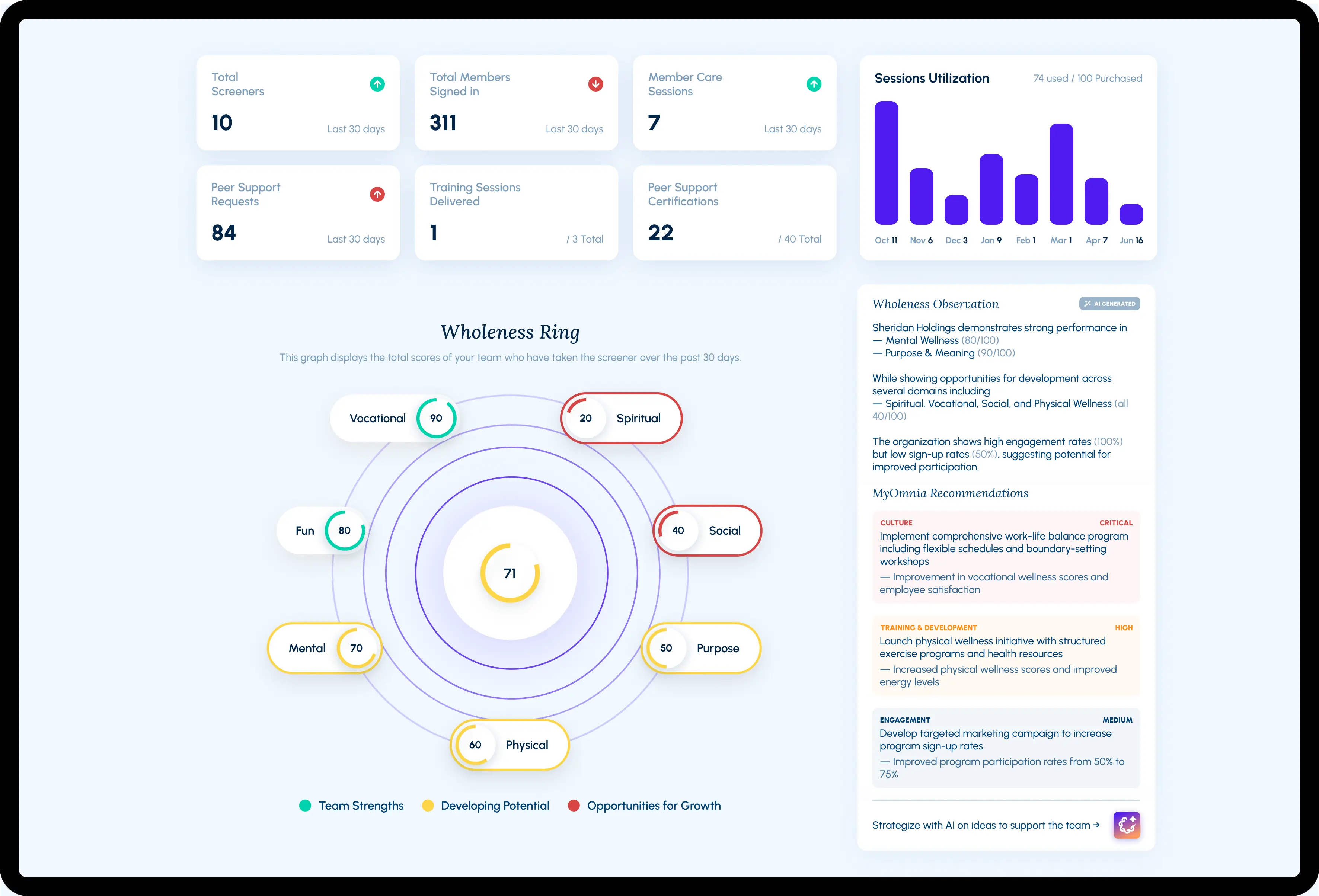
Wholeness-Based Consulting
We address emotional, psychological, relational, and organizational dimensions of well-being.
Preventive Burnout Strategies
Proactive education, resilience-building, and early intervention to reduce long-term risk.
Ongoing Well-being Programs
Sustainable initiatives that embed well-being into workplace culture.
For organizations dealing with worker burnout, MyOmnia's model supports sustainable health, going beyond crisis response to empower employees toward balance and productivity.
Best Practices to Reduce Worker Burnout in Organizations
Preventing burnout and prioritizing employee well-being are key strategies to promote retention and build a positive, balanced work environment. Burnout prevention is most effective when EAP support is paired with intentional leadership and culture.
Key strategies include:
- Early identification of burnout warning signs
- Normalising conversations around mental health
- Encouraging EAP utilisation without stigma
- Training leaders in empathy-driven management
- Promoting boundaries, rest, and recovery
These steps not only help burned-out employees recover but also enhance overall employee mental health and organizational well-being. When employees feel supported and not monitored, they are more likely to engage, perform, and stay.
Conclusion
Addressing worker burnout is essential for maintaining a healthy, productive, and engaged workforce. Organizations that wait until burnout becomes a crisis risk higher absenteeism, turnover, and long-term cultural damage.
Effective EAP support plays a central role in preventing and mitigating burnout. By offering confidential counselling, mental health resources, and holistic well-being programs. With tailored EAP services, preventive strategies, and ongoing well-being programs, MyOmnia empowers employees to thrive, supporting sustainable organizational health and a workforce that is motivated, engaged, and resilient.
FAQs:
Q:What is the difference between stress and worker burnout?
Stress is typically short-term and situational. Worker burnout is the result of prolonged, unmanaged stress and leads to emotional exhaustion and disengagement (WHO, 2019).
Q:How do EAP vendors help burned-out employees?
EAP vendors provide confidential counselling, mental health support, stress management tools, and referrals that help employees cope and recover.
Q:Is an EAP only for crisis situations?
No. Effective EAP services focus on prevention, early support, and long-term well-being, not just crisis intervention.
Q:How is MyOmnia Health different from large EAP providers like ComPsych?
While providers like ComPsych EAP provider offer scale, MyOmnia Health delivers personalized, holistic, and prevention-focused wellbeing solutions tailored to each organization.
References
- Moodle. (2025, January 28). Over half of American employees have used AI to take workplace training, according to new data. Moodle. https://moodle.com/us/news/ai-for-workplace-training-in-america/
- World Health Organization. (2019, May 28). Burn‑out an “occupational phenomenon”: International classification of diseases. https://www.who.int/news/item/28-05-2019-burn-out-an-occupational-phenomenon-international-classification-of-diseases
- Talkspace. (2024, October 25; updated 2025, April 11). The harsh costs of employee burnout on businesses. Talkspace. https://business.talkspace.com/articles/costs-of-employee-burnout

.png)






.png)