.png)


In today’s fast-paced world, where the lines between work and life blur under the weight of digital demands and global change, the call for effective mental health support has never been stronger.
According to the World Health Organization (WHO), around 15% of working-age adults live with a mental disorder, and globally, an estimated 12 billion working days are lost every year to depression and anxiety alone, costing the world economy nearly US$1 trillion in lost productivity. (World Health Organization, 2024)
Enter the digital age of mental health: online solutions, virtual counselling, and employee-wellbeing platforms. How do they measure up? How can organizations step in to support their people? And how is MyOmnia carving out a place in this evolving landscape, offering a platform for mental health, mental illness solutions, employee counselling services, and depression solution initiatives that matter?
Understanding Mental Health Challenges Today
Mental health challenges such as depression, anxiety, and stress-related disorders are more common than many realize. Depression, characterized by persistent sadness, loss of interest, and fatigue, affects globally an estimated 280 million people who live with depression and 301 million with anxiety disorders (Cuijpers, Javed, & Bhui, 2023).
In the workplace, these conditions carry both human and economic costs: confidence, identity at work, capacity to function, and job retention all suffer. Recent data reveals 76% of U.S. workers experience at least one mental health symptom, with 1 in 6 facing issues in the workplace. (U.S. Dept. of Health & Human Services, 2025)
For instance, in the UK in 2022/23, roughly 875,000 workers reported work-related stress, depression, or anxiety, resulting in 17.1 million days lost. (Mental Health Foundation). Untreated mental illness doesn’t just affect individuals; it ripples through teams, organizations, and society. Fatigue, disengagement, absenteeism, turnover, and presenteeism all increase.
Mental Illness Solutions: What Works
When we talk about solutions for mental illness (including depression, anxiety, and other disorders), several effective approaches stand out:
- Professional therapy & counselling: In-person or virtual sessions with qualified clinicians remain foundational.
- Digital interventions & platforms: Online tools, apps, self-help modules, and monitoring platforms are increasingly evidence-based. For instance, a recent umbrella review found digital tools are moderately to highly effective in reducing symptoms of depression and anxiety. (Kim et al., 2023)
- Self-help strategies: Lifestyle adjustments (exercise, sleep hygiene, social connection, mindfulness) alongside digital or face-to-face care.
- Tailored, hybrid approaches: Combining digital tools with human counselling improves reach, engagement, and outcomes.
Therefore, a true “mental illness solutions” framework is a multi-layered one that doesn’t replace human care but augments it with digital accessibility, tracking, self-help, and prevention.

Employee Counselling Services in the Workplace
For employers, providing dedicated mental health support is no longer an option; it is a responsibility that yields measurable returns. Employee counselling services, often provided through Employee Assistance Programs, or EAPs, are critical high-touch components of organizational well-being strategy. Employee counselling services typically include
- Confidential counselling sessions (in-person or virtual)
- Mental-health assessments and screening
- Workshops on stress, resilience, coping
- Crisis support, referral pathways
- Ongoing monitoring and well-being programs
Employee assistance programs (EAPs) have been shown to significantly reduce workplace stress and prevent burnout by providing early access to confidential counselling and organizational support. For example, one study found that employees using EAPs showed significantly greater reductions in absenteeism and presenteeism compared to those who did not. (Richmond et al., 2017)
Organizations offering Employee Assistance Programs (EAPs), digital modules combined with counsellors, mental-wellness days, and flexible schedules to reduce burnout. The key is embedding mental health into the organizational culture, not as an afterthought, but as a strategic pillar.
How a Platform for Mental Health Can Help
The digital age has revolutionized how we seek and receive mental health support, eliminating key barriers like geographical distance, scheduling conflicts, and the fear of visible attendance at a clinic.
A dedicated platform for mental health leverages technology to make high-quality care accessible, confidential, and personalized. These platforms offer significant advantages:
- Accessibility: Virtual therapy and counselling sessions are available on-demand or by easy appointment, fitting into busy schedules.
- Confidentiality: Many users feel safer engaging with digital tools privately.
- Personalized care: Through progress tracking, tailored modules, and user analytics.
- Integration with professional support: Platforms can bridge self-help with clinician input.
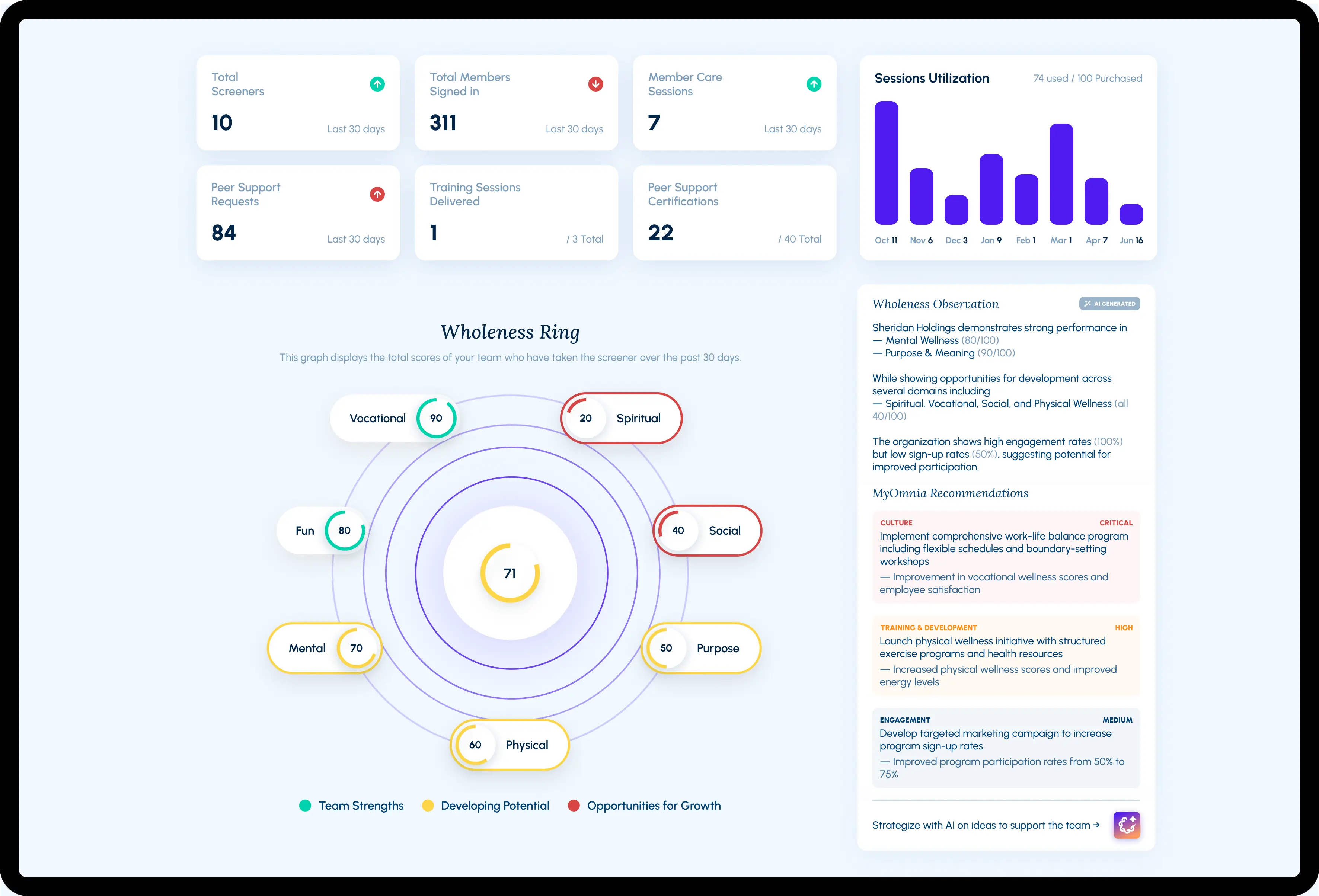
This is where MyOmnia steps in: positioning itself as a comprehensive platform for mental health, offering virtual counselling, self-help modules, tracking tools, and the Wholeness Screener, which evaluates seven domains for tailored AI-guided resilience pathways and peer-support networks, all designed for both individuals and organizations.
Depression Solutions: Addressing the Silent Struggle
“Depression often whispers; let’s make sure it’s heard.”
Depression remains one of the most pervasive mental health conditions, affecting an estimated 5.7% of adults globally (WHO, 2025). It results in lowered productivity, increased absenteeism, impaired relationships, and serious risk if untreated.
Effective depression solutions encompass:
- Early screening and assessment
- Evidence-based therapy (CBT, interpersonal therapy)
- Lifestyle interventions (physical activity, social connection, nutrition, sleep)
- Digital interventions that support and monitor progress
- Crisis support for severe cases
Within the MyOmnia framework, depression solutions are offered via timely access to professional support, aided by the platform’s digital infrastructure. That means users don’t wait weeks for an appointment; they can engage with licensed practitioners quickly, track their progress, and access self-help tools and guided modules while waiting for or complementing counselling.
Organizational Role in Mental Health Support
Employers and organizations hold tremendous responsibility when it comes to mental health support. The environment, culture, leadership, and policies all matter. Here are strategic actions firms can take:
- Promote mental-health literacy: raise awareness, destigmatise help-seeking
- Implement flexible scheduling, remote working options, workload review
- Provide robust employee counselling services and digital platform access
- Encourage peer-support networks, mentorship, check-ins
- Monitor and respond to metrics (absenteeism, turnover, engagement)
Combining employee counselling services with a platform for mental health creates a holistic ecosystem: professional support + digital infrastructure + organizational culture. The result is improved resilience, reduced burnout, stronger retention, and healthier teams.
MyOmnia’s Role in Supporting Mental Health
MyOmnia’s mission is clear: to provide accessible, confidential, effective mental health solutions to both individuals and organizations. What sets MyOmnia apart?
- A robust platform for mental health offering virtual therapy, self-help tools, real-time tracking, and peer-support networks.
- Tailored employee counselling services for companies so organizations can deliver professional support within a digital ecosystem.
- Focused depression solutions built into the platform with pathways for screening, early intervention, and follow-up.
- An approach that blends technology and human expertise: digital tools don’t replace clinicians; they amplify reach, enhance monitoring, and support engagement.
By integrating these elements, MyOmnia helps build resilient individuals and thriving workplaces.
Resources & Support Networks
If you or someone you know is struggling, professional support is available immediately. Seeking help is an act of strength, not a sign of weakness. Here are trusted resources:
- National Alliance on Mental Illness (NAMI): Provides advocacy, education, support, and public awareness so that all individuals and families affected by mental illness can build better lives.
- World Health Organization (WHO) Mental Health Resources: Offers global data, guidance, and resources for mental health promotion and care.
- MyOmnia’s Employee Assistance & Mental Health Solutions: Explore our platform for immediate access to virtual counselling and personalized self-help tools.
If you or a colleague are struggling, remember: you’re not alone. Seeking professional support is a sign of strength, not weakness. Let’s remove the stigma together.
Conclusion
Mental health matters now more than ever. The growing prevalence of depression, anxiety, and stress-related conditions challenges individuals, workplaces, and society. But we are not powerless.
By combining professional therapy, evidence-based digital tools, strong employee counselling services, and organizational commitment, effective mental illness solutions are within reach. Platforms like MyOmnia embody this integrated model: providing a platform for mental health that organisations can leverage and individuals can trust.
Mental health matters; explore MyOmnia’s platform today for expert guidance, employee counselling services, and effective depression solutions
References
- World Health Organization. (2024, September 2). Mental health at work. https://www.who.int/teams/mental-health-and-substance-use/promotion-prevention/mental-health-in-the-workplace World Health Organization
- Cuijpers, P., Javed, A., & Bhui, K. (2023). The WHO World Mental Health Report: A call for action. British Journal of Psychiatry, 222(6), 227-229. https://doi.org/10.1192/bjp.2023.9
- U.S. Department of Health & Human Services, Office of the Surgeon General. (2025, January 24). Workplace mental health & well-being. https://www.hhs.gov/surgeongeneral/reports-and-publications/workplace-well-being/index.html
- Kim, J., et al. (2023). Effectiveness of digital mental health tools to reduce mental disorders in low- and middle-income countries: A meta-analysis. PMC. https://www.ncbi.nlm.nih.gov/articles/PMC10131603/
- Richmond, M. K., Pampel, F. C., Wood, R. C., & Nunes, A. P. (2017). The impact of employee assistance services on workplace outcomes: Results of a prospective, quasi‑experimental study. Journal of Occupational Health Psychology, 22(2), 170‑179. https://doi.org/10.1037/ocp0000018
- World Health Organization. (2025, August 29). Depressive disorder (depression) fact sheet. https://www.who.int/news-room/fact-sheets/detail/depression
FAQs
Q1. What is the best platform for mental health support?
There’s no single “best” platform. The ideal one offers evidence-based tools, qualified human support, strong data security, ease of use, and works within a broader ecosystem of care. MyOmnia is designed to meet those standards.
Q2. How do employee counselling services benefit organisations?
They reduce absenteeism, presenteeism, turnover and cultivate a healthier, more engaged workforce. When employees know help is available, productivity and morale improve.
Q3. What are the most effective mental illness solutions for depression?
A combination of early screening, therapy (in-person or virtual), lifestyle interventions, self-help modules, and digital monitoring. What works for one person may differ from another, so tailored care is key.
Q4. How can digital platforms complement traditional therapy?
Digital tools can offer on-the-go access, self-help modules, progress tracking, and immediate support, bridging periods between sessions, broadening reach, and improving engagement.
Q5. How does MyOmnia provide accessible mental health support?
By offering a digital platform that connects users to virtual counselling, self-help tools and organizational programs. MyOmnia makes timely support accessible from anywhere—while maintaining confidentiality, professional oversight, and integration with workplace wellness programs.

.png)



.png)