
.png)


In 2023, Gallup reported that only 23% of employees worldwide were engaged at work, while burnout-related turnover was costing U.S. employers trillions annually. They are warning signals, and most organizations either missed them or had no system in place to catch them. That is exactly where workforce resilience becomes a competitive necessity.
Workforce resilience is a company's measurable capacity to absorb disruption, recover operational performance, and sustain employee well-being under pressure. Modern workforce analytics has made it possible to move beyond gut feelings and annual surveys into something organizations can actually act on.

What Workforce Resilience Actually Means
Resilience in the workplace is about whether your organization can bend without breaking when things get hard, whether that is a market shift, a restructuring, a global crisis, or chronic overload.
At the organizational level, it shows up as organizational adaptability: how quickly teams realign when priorities change, how smoothly operations continue during leadership transitions, and how fast performance bounces back after a disruption. At the individual level, it is about whether employees have the capacity to handle stress without tipping into burnout.
An employee who is chronically exhausted cannot perform. A team full of exhausted employees cannot adapt. Understanding workforce resilience means understanding this relationship between individual employee well-being and systemic organizational health.
Why Companies Are Measuring Workforce Resilience
The urgency around measurement did not come from nowhere. Several simultaneous pressures have made it impossible for organizations to fly blind:
- Burnout is accelerating. Burnout rates remain alarmingly high, with over 55% of U.S. employees reporting burnout in recent surveys, and fully remote workers hitting 61%
- Remote and hybrid work fractured visibility. Managers who once relied on observation now have far less insight into how their teams are actually doing. Absence of visibility has made proactive intervention harder.
- Retention has become a financial crisis. The cost of replacing an employee can range from 16% to 213% of annual salary depending on the role. When resilience fails, turnover follows.
- Productivity instability is spiking. Organizations are seeing unpredictable output drops that do not always tie to obvious causes, which is a classic sign of underlying workforce stress that has gone unmeasured.
How Workforce Analytics Measures Resilience
Workforce analytics transforms raw data into a clear picture of resilience that is not measured by a single metric. It emerges from patterns across multiple signals, interpreted together.
Indicators consist of the following.
- Absenteeism: Sudden spikes are typically indicative of an underlying problem (stress/disengagement).
- Turnover Rates: Primarily voluntary attrition from critical roles.
- Engagement Scores: Through pulse and interaction score.
- Productivity Variances: When measuring productivity through output metrics, there will be an adjustment for context.
- Employee Sentiment: Will be determined via AI analysis on comments, emails, and chat.
- Workload Distribution: Identifying unequal workloads which contribute to overload.
- Indicators of Stress: Such as working after hours or self-reported well-being.
Companies are interpreting these by looking for patterns in data. A team has rising absenteeism correlated to falling sentiment scores, which may reflect an early level of burnout. These patterns will allow HR to transition from a reactive response to issues to proactive support (such as offering specific support solutions) before problems arise.

The Role of HR Data Analytics
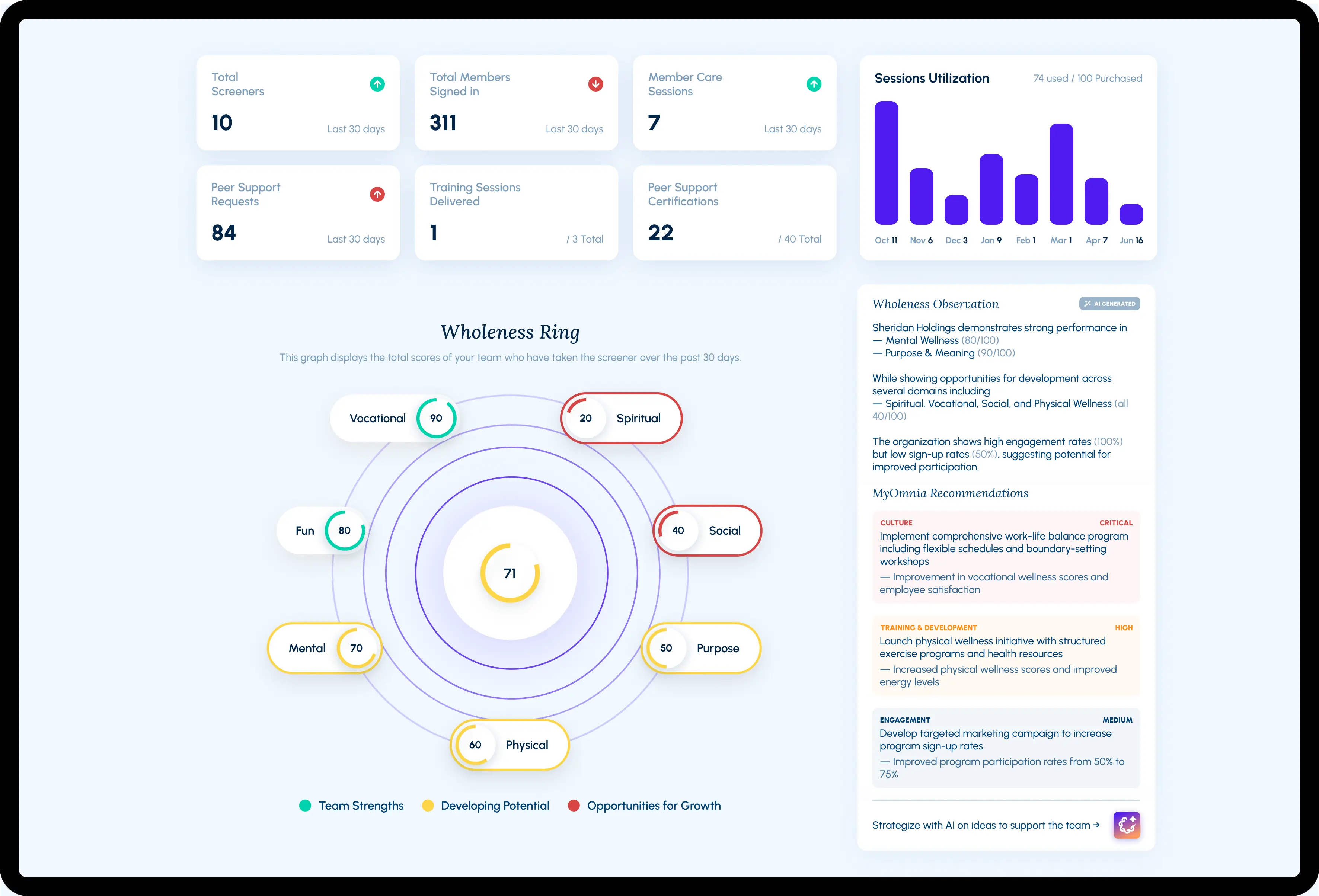
Modern HR data analytics has shifted the function from reactive reporting to predictive intelligence. HR dashboards that consolidate absenteeism, engagement, turnover, and performance data into a single view allow people operations teams to spot correlations that would be invisible in siloed systems.
Predictive analytics models can now estimate burnout probability by analyzing behavioral patterns: communication volume drops, declining participation in team meetings, and reduced output consistency. Several enterprise workforce platforms, including Workday and Microsoft Viva, have built these signals directly into their people analytics suites.
The shift toward real-time well-being monitoring is also changing what HR can act on. Rather than waiting for a quarterly survey to confirm what managers already suspect, organizations using continuous listening tools can intervene weeks earlier, when there is still time to make a difference.
Key Workforce Resilience Metrics
Common Mistakes Companies Make
Most organizations have the data. The failure is in how they use it, or don't.
- Over-relying on annual engagement surveys. A single annual survey cannot detect a resilience crisis building over six months. By the time results are in, the damage is done.
- Tracking productivity without wellbeing context. High output numbers can mask severe burnout. An employee delivering at 110% for six consecutive months is not thriving; they are likely approaching collapse.
- Ignoring burnout indicators until turnover confirms them. Burnout precedes departure by months. If your analytics only trigger after someone resigns, you are measuring consequences instead of causes.
- Collecting data without closing the loop. Survey fatigue is real. When employees report concerns and nothing changes, future data becomes unreliable. Analytics must connect to action.
Future of Workforce Resilience Measurement
AI-powered workforce analytics is rapidly closing the gap between data collection and actionable insight. Platforms are moving toward predictive workforce intelligence that can flag individual burnout risk before managers notice behavioral changes, and model the impact of organizational decisions on workforce stability before they are implemented.
Real-time well-being monitoring, through wearables, communication pattern analysis, and continuous pulse tools, is becoming more sophisticated and more ethically complex. The organizations that will lead in this space are those that build transparency and employee trust into their data practices from the start.
The future of workforce resilience measurement is not just smarter tools. It is a smarter relationship between data, leadership, and the humans the data represents.

.png)






.png)